
New Series: When Love and Money Speak Different Languages
“I’m not trying to be cheap! We need to build our savings!”
“It’s not that expensive. Sheesh, I was just trying to show you I care. You could be more grateful.”
If you’ve ever had a tense exchange or an argument with your spouse about money, it might not simply be because one is spending money and the other isn’t.
Money isn’t only about numbers, it’s often about what matters to us, and what makes us feel safe, acknowledged, connected and appreciated. And in relationships, how we handle money is often deeply tied to how we give love to our spouse and resonate with the love given to us.
I have been pondering this article series for a while, because so many people say that what they need is communication help with their money. This can be true – sometimes our word can be hurtful and cutting when it comes to spending or saving money.
But equally as often, we’re quarreling because they way our spouse is spending money (behaving) doesn’t resonate with us (feeling loved and seen) because they are spending money in a way that is meaningful to them.
Have you ever noticed that financial conflict with your spouse doesn’t always make sense on the suafrface? Maybe you argue about going out to eat, gift giving, budgeting or what counts as a “reasonable” expense. But underneath the numbers, something else might be going on: your love languages might be clashing.
What are the 5 Love Languages?
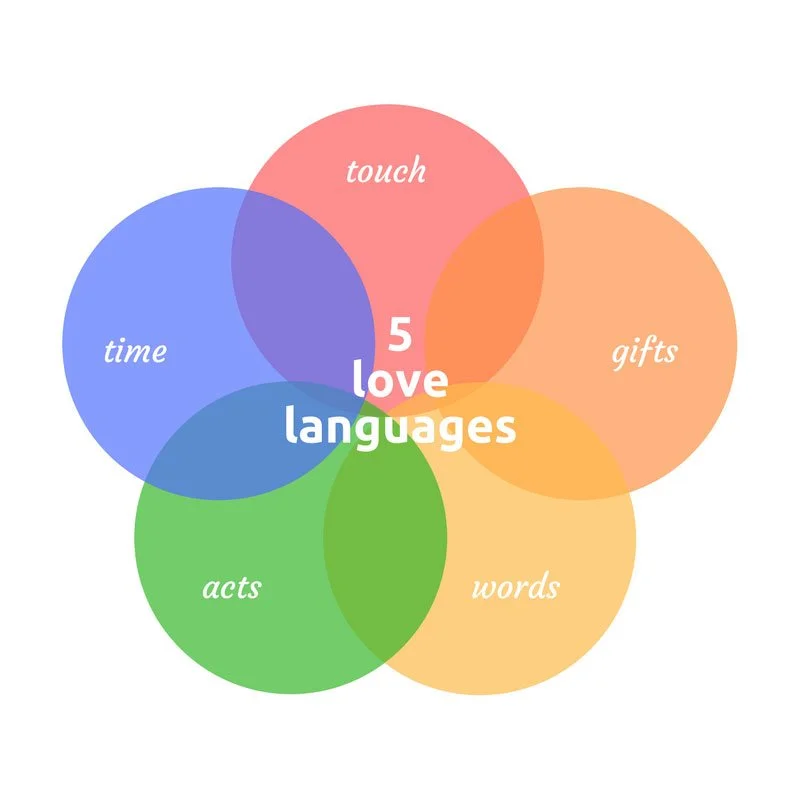
Dr. Gary Chapman’s concept of love languages helps explain how we connect with each other. The five languages are:
Words of Affirmation – feeling loved through verbal encouragement, praise, and appreciation.
Quality Time – feeling loved through focused, uninterrupted time together.
Receiving Gifts – feeling loved through thoughtful, meaningful presents.
Acts of Service – feeling loved when someone helps lighten your load.
Physical Touch – feeling loved through physical closeness and contact.
Most of us give and understand love in one or two of these ways. I often say that we know our love language when an a word or deed resonates deeply with us. The trouble is, our spouse or loved one often speaks a different language….and even more problematic: It’s very hard to speak the other person’s love language!
Speaking someone else’s love language is hard because so easy to understand and accept love the way you resonate with it.
This is especially true of those who value acts of service or receiving thoughtful gifts. Often the practicality of an act of service seems so reasonable it can make the “Act of Service” person confused when their spouse doesn’t understand a cleaned-up or organized home as love. I’ve heard friends and family debate this very thing: “But it’s so practical! How can someone not understand that it’s loving?”
Enter the person who values Words of Affirmation. All they want is to know that their spouse thinks they are beautiful, competent, attractive, or hear that they’re doing a great job. And if an “Acts of Service” person doesn’t believe others when they themselves are complimented,
you can immediately see how these two types would not only talk right past each other, but also love and spend right past each other.
Love Languages Show Up in Our Financial Habits
Here’s where it gets interesting: the way we handle money is often influenced by our love language — and by the way we perceive our partner’s.
If you show love by giving gifts, you might struggle to understand a partner who always wants to cut costs.
If your love language is quality time, you might long for date nights and vacations — and feel dismissed when your partner says, “We can’t afford that right now.”
Someone who values acts of service might see budgeting and financial planning as an act of love. But if their partner needs verbal reassurance or affectionate gestures, that spreadsheet might fall flat.
When Love Languages Collide
When we speak different love languages, it’s easy to misread each other’s intentions — especially around money. You might interpret your partner’s careful spending as a lack of generosity. They might interpret your purchases as irresponsible or impulsive.
Neither of you is necessarily wrong. Sometimes careful spending can feel like a lack of generosity — but often, how we interpret our partner’s behavior depends on the lens we choose.
When we assume the best, we’re more likely to see thoughtfulness instead of stinginess, caution instead of control. Similarly, when we interpret spending as a way of providing for loved ones or as a way of giving a gift and saying, “I was thinking of you,” we can respond in a way that reduces conflict, instead of stoking the fire of irritation.
What’s Next?
Over the next few weeks, I’ll share a series that explores each love language through the lens of money. We’ll look at how each language shows up in spending, saving, and decision-making — and how knowing your partner’s (and your own) love language can lead to fewer money fights and deeper connection.
For Now, a Question:
What’s one recurring money disagreement in your relationship — and what might it be really about?
TL;DR:
Ever wonder why you and your spouse keep fighting about money—even when it doesn’t seem like a big deal?
It might not be about dollars and cents at all. Money often reflects how we give and receive love. Your budgeting habits, gift-giving preferences, or spending choices might be speaking your love language—but missing theirs.
This post introduces how Dr. Gary Chapman’s 5 Love Languages show up in financial decisions.
When love languages collide, even well-meaning actions can feel frustrating or dismissive. But with awareness and curiosity, money can become a bridge to deeper connection instead of a source of tension.
Coming up: A full series on how each love language plays out with money—and how to connect more meaningfully through it.
